The Freiburger Pipe Organ
|
|
The Story of the Organ:
The Freiburger Organ of First Lutheran Church became a reality after the August 1974 fire damaged the former church pipe organ. The insurance company paid the replacement cost of that organ, which was estimated at $25,000. A local family graciously paid the balance of this grand instrument, valued at over $60,000 when it was purchased in 1976.
The Freuberger Orgelbau consulted directly with Mr. Robert Lund, architect of the new sanctuary. Engineering and construction required scale models of both sanctuary and organ. Mr. Karl Halvorson wrote the specifications for the organ in consultation with Mr. Hartwig Spath. Mr. Hartwig Spath was congratulated for surmounting the engineering difficulties implicit with the building of the new sanctuary. Everyone involved was very proud of the fine instrument dedicated to the glory of God, to the enrichment of the worship life of First Lutheran Church and to the cultural appreciation of the Glasgow community.
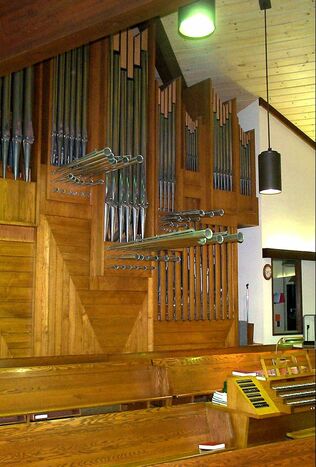
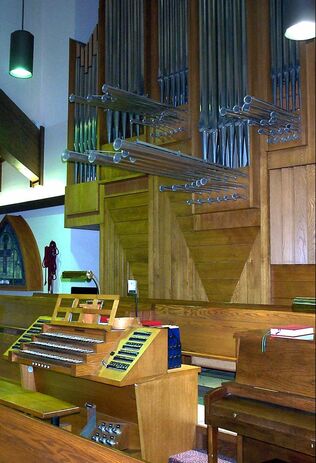
The specifications for the organ were drawn up by August Spath, orgelbaumeister, and Hartwig Spath, orgelbaumeister, in consultation with Mr. Karl E. Halvorson of Washington, D.C. (Helen Marten's brother). The organ included a 3-manual console with pedals and twenty-five stops. The pipes consist of 38 ranks and 1954 individual pipes. The wood came from the Black Forest of Germany. The pipes and the entire instrument were built, put together, taken apart and loaded into a semi-trailer. It was driven to the North Sea where the trailer was loaded onto a ship bound for New York City, then hauled to Montana. When the semi-trailer arrived in Glasgow members of the parish helped to haul each pipe, piece by piece into the church.
The organ was built to tonally reflect the German Organ School but also includes a rank of horizontal Spanish trumpets and a unique cimblestern of twelve tuned bells.
The installation of the organ in the church was supervised by Mr. Hartwig Spath, casework by Mr. Klaus Heitler and voicing by Mr. Peter Mebold, from Germany. Assistance was given by Mr. Harold Curryer, organ technician from Spokane, Washington. There was no instruction manual or directions given from the non-English speaking Germans.
Technical Details:
Console - Detached of the organ, three manuals and pedal. Manual keys with Grenadill-wood, sharps in oak with ivory tops. Measures correspond to AGO specifications. Pedal board in oak, sharps with ebony tops, organ bench in oak with adjustable top.
Windchests - Slider chests for each manual and pedal. Frames and plates of specially fabricated marine plywood, adapted to our climate. Slides of synthetic material. Nearly all pipe-holes go straight to the pipes, to give a direct wind. The air reservoir is constructed as the bottom of the chest, in order to allow an ever-stead wind supply. The pallets (valves) in the chest are warp-proof, and are designed to permit an abundance of wind to the note-channels.
The Freiburger Organ of First Lutheran Church became a reality after the August 1974 fire damaged the former church pipe organ. The insurance company paid the replacement cost of that organ, which was estimated at $25,000. A local family graciously paid the balance of this grand instrument, valued at over $60,000 when it was purchased in 1976.
The Freuberger Orgelbau consulted directly with Mr. Robert Lund, architect of the new sanctuary. Engineering and construction required scale models of both sanctuary and organ. Mr. Karl Halvorson wrote the specifications for the organ in consultation with Mr. Hartwig Spath. Mr. Hartwig Spath was congratulated for surmounting the engineering difficulties implicit with the building of the new sanctuary. Everyone involved was very proud of the fine instrument dedicated to the glory of God, to the enrichment of the worship life of First Lutheran Church and to the cultural appreciation of the Glasgow community.
The specifications for the organ were drawn up by August Spath, orgelbaumeister, and Hartwig Spath, orgelbaumeister, in consultation with Mr. Karl E. Halvorson of Washington, D.C. (Helen Marten's brother). The organ included a 3-manual console with pedals and twenty-five stops. The pipes consist of 38 ranks and 1954 individual pipes. The wood came from the Black Forest of Germany. The pipes and the entire instrument were built, put together, taken apart and loaded into a semi-trailer. It was driven to the North Sea where the trailer was loaded onto a ship bound for New York City, then hauled to Montana. When the semi-trailer arrived in Glasgow members of the parish helped to haul each pipe, piece by piece into the church.
The organ was built to tonally reflect the German Organ School but also includes a rank of horizontal Spanish trumpets and a unique cimblestern of twelve tuned bells.
The installation of the organ in the church was supervised by Mr. Hartwig Spath, casework by Mr. Klaus Heitler and voicing by Mr. Peter Mebold, from Germany. Assistance was given by Mr. Harold Curryer, organ technician from Spokane, Washington. There was no instruction manual or directions given from the non-English speaking Germans.
Technical Details:
Console - Detached of the organ, three manuals and pedal. Manual keys with Grenadill-wood, sharps in oak with ivory tops. Measures correspond to AGO specifications. Pedal board in oak, sharps with ebony tops, organ bench in oak with adjustable top.
Windchests - Slider chests for each manual and pedal. Frames and plates of specially fabricated marine plywood, adapted to our climate. Slides of synthetic material. Nearly all pipe-holes go straight to the pipes, to give a direct wind. The air reservoir is constructed as the bottom of the chest, in order to allow an ever-stead wind supply. The pallets (valves) in the chest are warp-proof, and are designed to permit an abundance of wind to the note-channels.
Local Newspaper Article from 1976:
First Lutheran Gets $60,000 Organ
Folks at First Evangelical Lutheran Church have a number of reasons to be excited these days as they see their new sanctuary nearing completion.
One of the latest occasions for feeling good is the recent arrival of the new $60,000 custom-engineered and built Spath three manual with pedal organ.
Craftsmen from the factory in Freiburg, West Germany, along with the firm’s owner, Hartwig Spath, are currently assembling and installing the new organ at the church.
The crew includes, along with Spath, Peter Nebold, master organ builder and voicer (tuner); Klaus Heitzler, specialist mechanic and assembler; and Harold Curryer, voicer.
The men arrived in Glasgow a week ago last Sunday and estimate their task will be completed sometime around mid-December.
The 25-stop organ will be the third one to be installed in the United States. Texas, with its 26-stop organ, can’t boast the “biggest” this time. A 34-stop masterpiece was installed in Annapolis, MD.
A smaller 8-stop organ will be installed in the home of Dr. and Mrs. Robert L. Martens of Glasgow who ordered theirs along with the church unit.
The Martens’ installation will make the Glasgow family the only one in the United States owning a Spath organ.
As is often found in Europe, the art of “orgelbau” or organ building, is a family tradition that goes back to Great Grandfather Spath around the 1860’s who founded the business.
There are about 100 similar family companies in Germany dedicated to the art of custom engineering and building organs.
Spath’s factory, employing 15 persons, is located in Freiburg, a city of 170,000 people.
“We build about six organs a year,” reported the tall, lean German businessman. “Next year we will build four small organs for England and two for Berlin.”
Hartwig’s 100th organ, since taking the company over from his father in 1964, will be built for his own Catholic church in his home town.
The Glasgow Lutheran organ will have 1,954 pipes, most made of an alloy of tin and lead, with base pipes of mahogany.
Observed crewmember Nebold smilingly, “We should have made this one with 1.976 pipes for the Bicentennial.”
The organ has been on order for two years, a replacement for the former church organ damaged in the August 1974 fire. The insurance company paid the replacement cost of that organ, which was estimated at $25,000, and a church family paid the difference between that and the $60,000 cost of the Spath organ.
The German workmen are currently staying at the home of the Martens during the assembling, installation and tuning of the organ.
Dr. Martens is a former Presbyterian “with some Methodist thrown in” who describes church as “something I find very necessary in my life.”
Helen Martens is the church organist and is looking forward to developing her skills on the new instrument. She has been playing the organ for First Evangelical Lutheran since 1961.
Mrs. Dona Enebo serves as assistant organist and will also be ministering on the unique instrument.
One of the things that made the engineering and construction of the Breiburger Orgelbau difficult, according to Spath, was the fact that the church in which it was to be housed was not yet built; they had nothing to build to except the architect’s plans.
A scale model of the organ was built and sent to the architect who, in return, sent the organ builders a model of the church.
Spath, who was in the United States for the installation of the Annapolis organ last year, paid a visit to Glasgow and also visited with the church architect I Great Falls to discuss the new structure; its details and specifications.
A concert is planned for Sunday, January 16, the day also on which the new church will be dedicated.
First Lutheran Gets $60,000 Organ
Folks at First Evangelical Lutheran Church have a number of reasons to be excited these days as they see their new sanctuary nearing completion.
One of the latest occasions for feeling good is the recent arrival of the new $60,000 custom-engineered and built Spath three manual with pedal organ.
Craftsmen from the factory in Freiburg, West Germany, along with the firm’s owner, Hartwig Spath, are currently assembling and installing the new organ at the church.
The crew includes, along with Spath, Peter Nebold, master organ builder and voicer (tuner); Klaus Heitzler, specialist mechanic and assembler; and Harold Curryer, voicer.
The men arrived in Glasgow a week ago last Sunday and estimate their task will be completed sometime around mid-December.
The 25-stop organ will be the third one to be installed in the United States. Texas, with its 26-stop organ, can’t boast the “biggest” this time. A 34-stop masterpiece was installed in Annapolis, MD.
A smaller 8-stop organ will be installed in the home of Dr. and Mrs. Robert L. Martens of Glasgow who ordered theirs along with the church unit.
The Martens’ installation will make the Glasgow family the only one in the United States owning a Spath organ.
As is often found in Europe, the art of “orgelbau” or organ building, is a family tradition that goes back to Great Grandfather Spath around the 1860’s who founded the business.
There are about 100 similar family companies in Germany dedicated to the art of custom engineering and building organs.
Spath’s factory, employing 15 persons, is located in Freiburg, a city of 170,000 people.
“We build about six organs a year,” reported the tall, lean German businessman. “Next year we will build four small organs for England and two for Berlin.”
Hartwig’s 100th organ, since taking the company over from his father in 1964, will be built for his own Catholic church in his home town.
The Glasgow Lutheran organ will have 1,954 pipes, most made of an alloy of tin and lead, with base pipes of mahogany.
Observed crewmember Nebold smilingly, “We should have made this one with 1.976 pipes for the Bicentennial.”
The organ has been on order for two years, a replacement for the former church organ damaged in the August 1974 fire. The insurance company paid the replacement cost of that organ, which was estimated at $25,000, and a church family paid the difference between that and the $60,000 cost of the Spath organ.
The German workmen are currently staying at the home of the Martens during the assembling, installation and tuning of the organ.
Dr. Martens is a former Presbyterian “with some Methodist thrown in” who describes church as “something I find very necessary in my life.”
Helen Martens is the church organist and is looking forward to developing her skills on the new instrument. She has been playing the organ for First Evangelical Lutheran since 1961.
Mrs. Dona Enebo serves as assistant organist and will also be ministering on the unique instrument.
One of the things that made the engineering and construction of the Breiburger Orgelbau difficult, according to Spath, was the fact that the church in which it was to be housed was not yet built; they had nothing to build to except the architect’s plans.
A scale model of the organ was built and sent to the architect who, in return, sent the organ builders a model of the church.
Spath, who was in the United States for the installation of the Annapolis organ last year, paid a visit to Glasgow and also visited with the church architect I Great Falls to discuss the new structure; its details and specifications.
A concert is planned for Sunday, January 16, the day also on which the new church will be dedicated.